
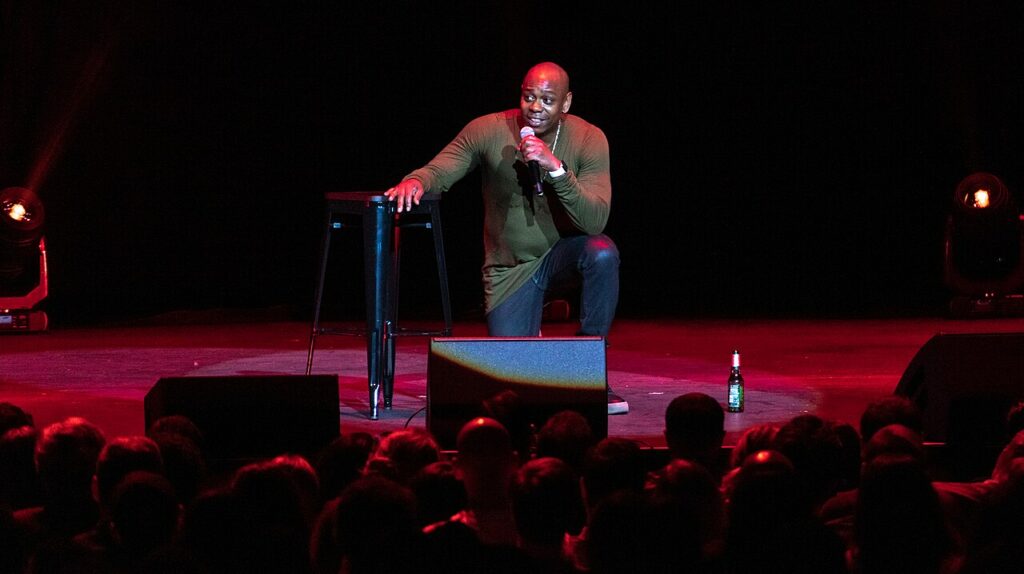
Dave Chappelle is drawing a line between his stand-up and the way it’s been used in the political arena, saying that Republicans have tried to turn his material into something he never intended.
“I did resent that the Republican Party ran on transgender jokes. You know, I felt like they were doing a weaponized version of what I was doing. That’s not what I was doing,” Chappelle told NPR’s Newsmakers this week.
His frustration centers on how jokes from his 2021 Netflix special The Closer moved beyond comedy and into campaign messaging, a shift he says distorted the intent behind his work.
That tension came into focus during an encounter on Capitol Hill that Chappelle says spiraled into something he couldn’t control.
NEW: Comedian Dave Chappelle says he resents the Republican Party for "weaponizing" his transgender jokes.
Chappelle also called out Lauren Boebert over an incident on Capitol Hill.
"I did resent that the Republican Party ran on transgender jokes. You know, I felt like they… pic.twitter.com/GnIjq6ZXDT
— Collin Rugg (@CollinRugg) April 15, 2026
He described taking photos with lawmakers without considering their politics, only to see one image later used in a way he hadn’t agreed to.
“I’ll give you an example, before I learned the phrase, ‘I respectfully decline,’ I was on Capitol Hill, and everybody ran up to take pictures with me from every congressional office,” he explained.
“And I just take pictures with whoever asked. I didn’t ask how they vote or what their voting record is,” he noted.
“At first, it was CBC people,” he continued. “Then here comes Lauren Boebert and she said, ‘Can I get a picture?’ And I had already taken 40 pictures. I didn’t want to say no in front of everybody, but I didn’t know the phrase ‘I respectfully decline.’ So I just took the picture.”
The fallout came almost immediately. Chappelle said Boebert posted the image with a caption suggesting they shared the same stance on gender issues, something he says crossed a line.
“And then she posted the picture before I could even get from there to the show and says something to the effect of, ‘Just two people that know that it’s just two genders,’” he recalled.
“Just instantly, like, weaponized or politicized. So I got to the arena, and I lit her ass up for doing that,” he noted.
“And she should never do that to a person like me. You do whatever it is you do, but don’t — get me out of the splash zone…”
NPR: “People think President [Trump] is funny … Do you think he's funny?”
CHAPPELLE: “There are funny things about him … but what he does is so consequential. In my lifetime, I've never really seen a phenomenon quite like him.” pic.twitter.com/4YLdXYvzLc
— Chief Nerd (@TheChiefNerd) April 15, 2026
The dispute ties back to The Closer, which triggered immediate backlash when it debuted.
In that special, Chappelle said he was “team TERF,” referenced debates over gender identity, and challenged what he described as a growing push to limit what comedians can say.
He didn’t walk any of that back in his 2023 special The Dreamer, instead doubling down on his broader point about creative freedom.
Around that time, he said on his podcast The Midnight Miracle that disagreement from audiences didn’t bother him, but restrictions on speech did.
The very first joke in Dave Chappelle's new special, The Dreamer, is about the ridiculousness of being pressured to go along with the lies of transgenderism. pic.twitter.com/6PKYEi5dvL
— Genevieve Gluck (@WomenReadWomen) January 1, 2024
That stance carried into his NPR interview, where he dismissed the idea that his platform should change how he approaches his work.
“If being ‘big’ informs me in such a way that I feel like I don’t want to step on any hands or any blades of grass, I don’t want to hurt anybody, then so be it — that’s what I decide,” he lamented.
“But I I have yet to make those types of decisions. I don’t feel like anything I do is malicious or even harmful,” he pointed out.
🎇Honor America’s 250th Anniversary!!!🎇 Get your 2026 Heritage Foundation commemorative membership card ➡️➡️➡️ ACTIVATE YOUR MEMBERSHIP NOW!!! 🇺🇸🇺🇸🇺🇸
“And I think if I did hurt somebody with my work, boy, they would have been laid that at my feet. I’m just not doing that.”
Chappelle also took a dig at Donald Trump during the interview, when asked if he thought that the president was funny.
“Maybe if he wasn’t president,” the comedian replied. “There are funny things about him … but what he does is so consequential. In my lifetime, I’ve never really seen a phenomenon quite like him.”
Chappelle also took aim at critics he says are trying to dictate the boundaries of comedy.
“If you’re a person that … feels like you have to police comedy to get your point across, you should assess your point,” he remarked.
NPR: “You are not a trans person … What do you say to people who feel that in some occasions you're punching down?”
CHAPPELLE: “If you're a person that … feels like you have to police comedy to get your point across, you should assess your point.” pic.twitter.com/7mcpgEC8IO
— Chief Nerd (@TheChiefNerd) April 15, 2026
That same argument has shaped his response to venues that pulled or questioned his performances following the controversy.
“I guess apparently they had made a pledge to the public at large that they would make their club a safe space for all people, and that they would ban anything they deemed transphobic,” Chappelle said in 2023, referring to Minneapolis’ First Avenue theater.
“This is a wild stance for an artistic venue to take, especially one that’s historically a punk rock venue.”
“I’m not even mad [people] take issue with my work. Good, fine. Who cares?” he added.
“What I take issue with is the idea that because they don’t like it, I’m not allowed to say it.”
While the backlash has remained intense, Chappelle said his support system has stayed intact, particularly in his hometown.
“I’ve had a lot of support from my people,” he noted. “That’s what’s sustained me.”
He credited his community in Yellow Springs, Ohio, with giving him space to maintain perspective while the broader cultural fight plays out.
“One of the best sovereignties that a person can enjoy is the sovereignty of their mind,” he added. “Just the idea of knowing where you land and the rest of the world begins.”
Chappelle said the criticism surrounding his work often doesn’t match the response he sees from audiences.
“The media used to talk (expletive) about jokes that I did … and none of that stuff swayed my audience,” he commented. “So I feel like I need to be true to something.”
He framed that tension as part of a longer pattern, pointing to historical figures who faced sustained backlash before being reevaluated.
“It’s every negative thing they said about him,” Chappelle noted, referring to The Muhammad Ali Reader.
“And history proved him to be absolutely right. … As bad as that weather was, there’s another side to it.”
He extended that idea to cultural pressure, arguing that limits on speech often come with consequences attached.
“Black life in America, there’s always an ‘or else’ to all of it,” he stated. “Don’t say this or else; don’t do that or else. And then there’s those few brave people who say, ‘Or else what?’”
Even as he defends his past work, Chappelle has hinted at revisiting one of the projects that defined his career.
“If you’d asked me that question a year ago, I’d have told you absolutely not,” he told The Associated Press. “But in the last few weeks … I’m considering it.”
“Chappelle’s Show,” which premiered in 2003, became a major hit before he abruptly walked away during production of its third season in 2005, leaving behind a deal worth more than $50 million.
At the time, he said he was dealing with creative burnout and concerns about control over his work.